How to Prepare Your Boat for Winter Storage in Idaho
A step-by-step guide to properly winterizing and preparing your boat for Idaho's cold-weather storage season, from cleaning to covering to protecting your investment.
Why Winter Preparation Matters in Idaho
We know that Idaho winters can turn a minor maintenance oversight into a catastrophic repair bill by March.
The sub-freezing temperatures in the Treasure Valley and higher elevations create a harsh environment that actively attacks marine components.
Our team has seen too many cracked engine blocks and split manifolds caused by trapped water expanding during a freeze.
A proper winterization routine does more than just keep the boat clean.
It protects your financial investment from the specific “dry cold” and inversion layers that make Idaho winters unique.
Boats stored here without preparation face risks like dried-out seals, rodent infestation, and gelcoat oxidation from high-altitude UV exposure.
We generally recommend starting this process by mid-October.
Historical weather data for Boise indicates that the first hard freeze typically lands between October 10th and October 15th.
Investing a Saturday afternoon now saves you weeks of repair time when the reservoirs open back up in spring.
Step 1: Thorough Exterior Wash and Decontamination
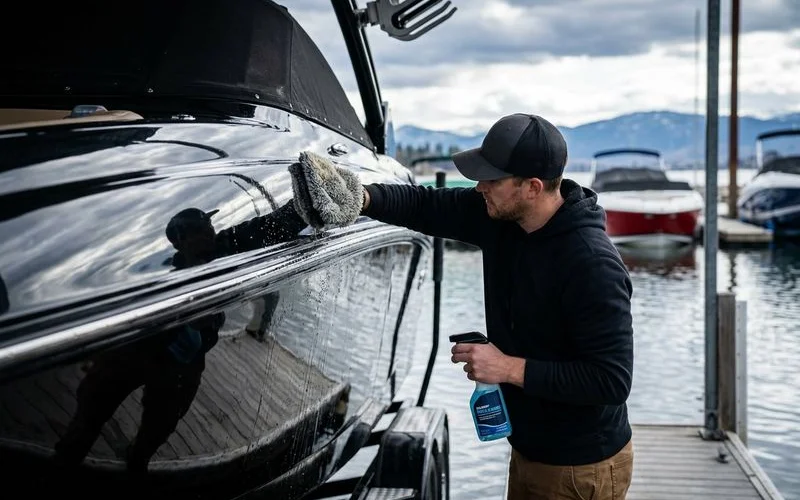
We start every boat detailing winterization job with a rigorous exterior decontamination to strip away the specific residue found in local waterways.
Idaho’s reservoirs, like Lucky Peak and Lake Lowell, are notorious for leaving hard water spots and mineral deposits on hulls.
Our technicians use a specialized acid-based hull cleaner, such as Star brite Hull Cleaner, to dissolve these calcium lines before they harden over winter.
You cannot rely on a simple soap wash to remove the microscopic algae and invasive species invisible to the naked eye.
Dealing with Invasive Species
We must address the issue of Quagga and Zebra mussels, which are a major concern for the Idaho State Department of Agriculture (ISDA).
Microscopic veligers can survive in damp crevices for weeks in cool weather.
Our crew utilizes water heated to at least 140°F (60°C) for the initial rinse, as this is the lethal temperature for these invasive organisms.
Leaving organic matter on the hull can lead to permanent staining and gelcoat blistering after months of storage.
Pay close attention to the trailer bunks and the transom.
These areas trap moisture and grime that accelerate corrosion on metal fittings.
Step 2: Address Gelcoat Protection
We always assess the gelcoat’s health immediately after washing, while the surface is stripped clean.
Oxidation spreads rapidly in Idaho’s thinner atmosphere because UV radiation increases by about 10% for every 3,000 feet of elevation.
Our shop recommends applying a polymer-based sealant rather than a traditional carnauba wax for winter storage.
Synthetic sealants, like those from Meguiar’s Marine line or 3M Perfect-It, bond longer and resist the temperature fluctuations common in our region.
A simple wax job might evaporate or break down by January, leaving your fiberglass exposed for the remainder of the season.
If you store your boat outdoors, this step is your primary defense against the elements.
We also suggest looking for “chalking,” which appears as a white powder on the surface.
This indicates the gelcoat is failing and needs a compound buffing before you seal it for the season.
Step 3: Interior Cleaning and Mold Prevention
We approach interior cleaning with a focus on fighting Idaho’s silent storage killer: condensation.
Even in our dry climate, temperature swings inside a covered boat create moisture that gets trapped in carpets and upholstery.
Our standard procedure involves removing every cushion and storing them in a climate-controlled space, like a garage or basement.
If you must leave cushions onboard, prop them up on their sides to ensure air can circulate around the foam.
Mold can take root in vinyl pores within 24 to 48 hours if moisture is present without airflow.
Managing Moisture and Pests
We rely on chemical dehumidifiers to keep the cabin dry.
Place two or three buckets of a desiccant, such as DampRid or Star brite No Damp, in the bilge and main cabin areas to pull moisture out of the air.
Our team also places dryer sheets or peppermint oil-soaked cotton balls inside compartments.
Idaho field mice are aggressive in winter and will chew through wiring harnesses and upholstery to build nests.
They detest the strong scent of peppermint, making it an effective, non-toxic deterrent.
Carpet and Bilge Care
We vacuum and scrub the carpets to remove food crumbs that might attract those pests.
Ensure the bilge is completely dry and free of oil residues.
Our mechanics use a wet/dry vac to remove every last drop of standing water.
Any remaining water will freeze and can crack bilge pumps or housing units.
Step 4: Critical Mechanical and Metal Care
We cannot stress enough that the engine and drive system require the most specific attention during an Idaho winter.
The cost of a cracked engine block from freezing water often exceeds $5,000.
Our technicians drain the cooling system completely and backfill it with non-toxic propylene glycol antifreeze rated for at least -50°F (-46°C).
Why -50°F matters:
- Burst Protection: Prevents pipes and blocks from cracking down to -50°F.
- Slush Point: The fluid may become slushy around +10°F but will not expand.
- Corrosion Inhibitors: Contains additives specifically for aluminum and rubber seals.
Air expands when it warms and contracts when it cools, causing condensation inside your fuel tank.
We always add a fuel stabilizer, such as Sta-Bil 360 Marine, and run the engine for 10 minutes to ensure the treated fuel reaches the injectors.
Protecting Hardware
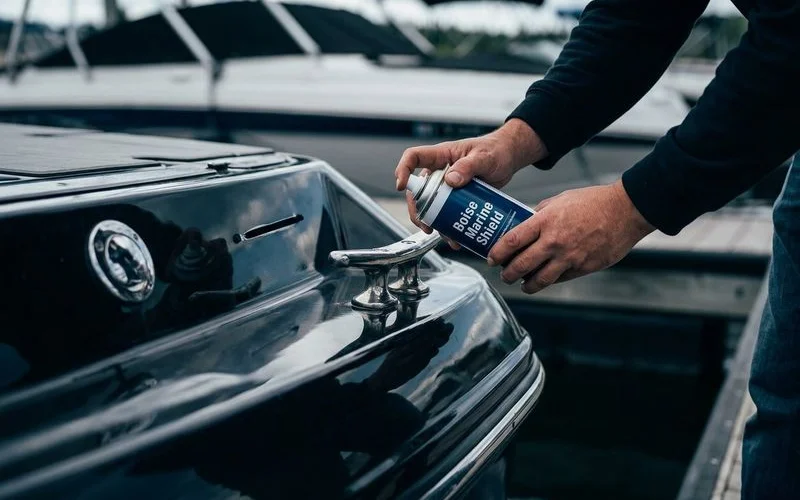
We coat all metal fittings with a corrosion inhibitor to prevent pitting.
Stainless steel and aluminum hardware will oxidize due to the moisture trapped under a boat cover.
Our crew sprays a light coat of CRC 6-56 or a similar marine protectant on cleats, rails, and hinges.
Lubricate the steering cable and prop shaft to prevent them from seizing during months of inactivity.
Step 5: Canvas and Cover Preparation
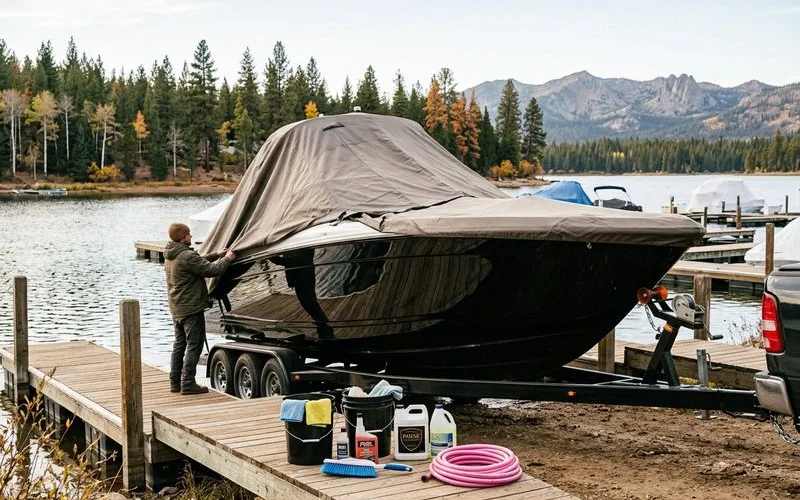
We see more damage caused by failing covers than almost any other external factor.
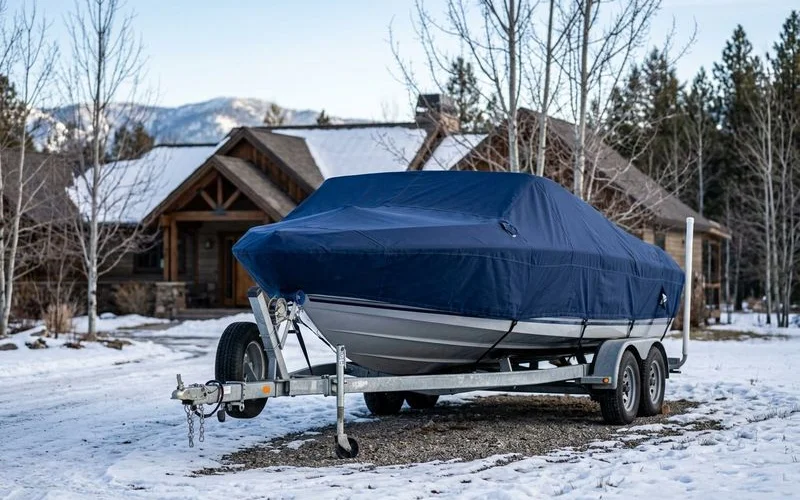
A cover that allows snow to pool will eventually tear under the weight, dumping hundreds of pounds of snow and ice directly into your cockpit.
Our team advises using a proper support pole system to create a steep pitch that sheds snow immediately.
Check every snap and seam on your canvas before storing it.
A small tear in November becomes a gaping hole by February after a few windstorms.
We recommend cleaning the canvas with a mildew remover and reapplying a waterproofing spray like 303 Fabric Guard.
Shrink-wrapping is the gold standard for outdoor storage in Idaho.
It creates a sealed, waterproof barrier that can withstand heavy snow loads and high winds better than any fabric cover.
Venting is Non-Negotiable
We install active vents in every shrink-wrap job we perform.
Dr. Shrink or Boat Vent II systems allow airflow to escape, preventing the “greenhouse effect” that breeds mold on sunny winter days.
Step 6: Trailer and Tire Maintenance
We frequently see boat owners neglect the trailer, only to find themselves with flat tires or seized bearings in spring.
Concrete floors suck the heat out of rubber tires, causing them to degrade and develop flat spots.
Our mechanics inflate tires to their maximum PSI rating to counteract the pressure loss that occurs in cold weather.
For every 10-degree drop in temperature, your tire pressure drops by roughly 1 PSI.
Block the trailer frame up on jack stands if possible to take the weight off the suspension and tires entirely.
Inspect the wheel bearings and top off the grease to push out any water that might have entered during the season.
Water in a bearing assembly will rust the races and pit the rollers while the trailer sits stationary.
Storage Environment Considerations
We help clients weigh the costs and benefits of different storage options every season.
Your choice of storage directly impacts how much preparation work is required.
Local rates in the Treasure Valley have fluctuated recently, so these estimates reflect the 2025-2026 market averages.
Comparative Storage Options
| Storage Type | Protection Level | Approx. Monthly Cost (Idaho) | Key Benefit | Key Risk |
|---|---|---|---|---|
| Indoor Heated | Maximum | $300 - $500+ | Zero freeze risk; battery stays warmer. | High cost; long waiting lists. |
| Indoor Cold | High | $175 - $300 | Protects from UV and snow; secure from theft. | Temperature still drops below freezing; full winterization required. |
| Outdoor Covered | Medium | $100 - $175 | Keeps rain/snow off; lower cost. | Susceptible to wind dust; temperature swings. |
| Outdoor Open | Low | $50 - $90 | Cheapest option. | High UV damage; heavy snow load risk; pest exposure. |
Moisture Management
We recommend checking your boat once a month regardless of where it is stored.
Swap out your moisture absorbers when they are full.
Our team has opened boats in spring that were “properly stored” but still had mold because the desiccant buckets filled up by January.
Spring Recommissioning
We find that a boat put away correctly is a joy to wake up in spring.
You essentially just need to charge the battery, check the fluids, and turn the key.
Our goal with this process is to ensure your first weekend on the water is spent boating, not troubleshooting repairs in the driveway.
That peace of mind is worth the effort you put in now.
Boise Mobile Auto Detailing Team
Professional detailing specialists serving Boise and the Treasure Valley.