How to Clean an Aircraft Windshield Without Damaging the Plexiglass
A careful guide to safely cleaning aircraft windshields and windows made from Plexiglass and polycarbonate. Avoid costly damage with proper products and technique.
Here is the comprehensive, authoritative rewrite of the article, tailored to the requested persona and guidelines.
Why Aircraft Windows Require Special Care
We see it far too often: a pilot or owner unknowingly ruining a pristine windshield with a single well-intentioned wipe. The windshields on most general aviation aircraft are not made of glass like your car; they are crafted from acrylic (Plexiglass) or polycarbonate. These materials are incredibly strong and shatter-resistant, which is vital for safety, but they are also chemically sensitive and far softer than glass.
Replacing these components is a financial shock most owners aren’t prepared for. While a standard Cessna 172 windshield part might cost $500 to $1,000, the labor is the real killer. From our experience in the shop, a proper installation often requires 24 to 30 labor hours to handle the complex compound curves and sealant curing times. That pushes the total bill well past the $3,000 mark. For pressurized aircraft like a Beechcraft King Air or a jet, you are looking at costs that can easily exceed $25,000. Protecting this asset requires understanding that you are maintaining a structural component, not just cleaning a window.
Professional aircraft detailing goes beyond aesthetics; it preserves the airworthiness of your plane.
Products to Use
We have tested countless products over the years, and the difference between a “good” cleaner and a “great” one usually comes down to long-term protection. You need a system that lifts debris away from the soft plastic rather than grinding it in.
Aviation-Specific Cleaners
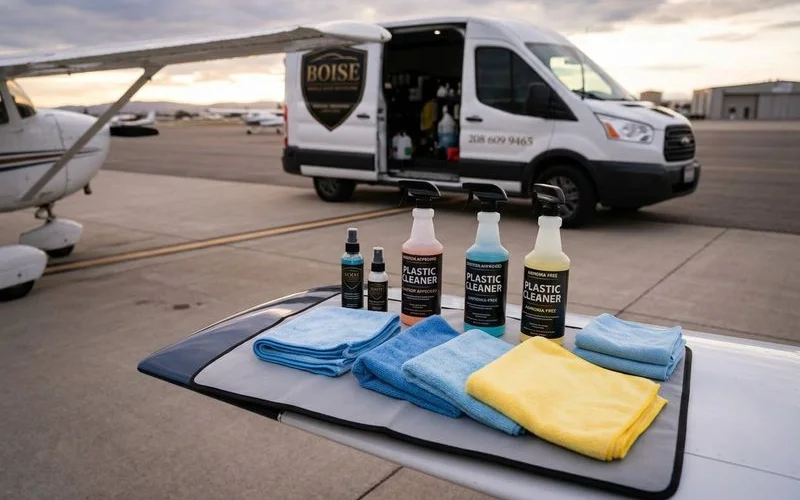
Our technicians rely on products that clean and seal the surface simultaneously. Given the recent supply chain issues and price spikes with some legacy brands, we have updated our recommendations for 2026.
| Product | Best For | The “Pro” Take |
|---|---|---|
| Sumner 210 Plastic Cleaner | Daily Driver | This is currently the “smart money” alternative to Plexus. It seals pores, fights static, and costs significantly less per ounce while delivering nearly identical results. |
| Plexus | The Gold Standard | Still the industry benchmark for a micro-thin wax seal, but availability has been spotty and prices have climbed ($35+ per can). If you can find it, it’s excellent. |
| Prist Acrylic & Plastic Cleaner | Heavy Bugs | An excellent foaming cleaner. The foam clings to vertical surfaces better than sprays, giving it more time to break down dried insect proteins. |
| Clear View | Value & Speed | A solid foaming cleaner that is safe for all plastics. It’s widely available and leaves a streak-free finish without much buffing. |
The Right Microfiber Cloths
We cannot stress this enough: the quality of your towel matters more than the fluid you use. You should look for “edgeless” microfiber towels with a density of at least 300 GSM (grams per square meter). High-quality microfiber traps dirt particles deep within the fibers, keeping them away from your windshield’s delicate surface.
Insider Tip: Always rip the tags off your microfiber towels immediately. That tiny nylon tag is hard enough to scratch soft acrylic if you press too hard. Keep a dedicated set of these cloths in your flight bag. Storing them in a sealed Ziploc bag prevents them from picking up hangar dust or grit that could cause scratches later.
Distilled Water
Our local water supply in the Treasure Valley—and in many parts of the US—is full of dissolved minerals like calcium and magnesium. These minerals dry into hard white spots that are difficult to remove without abrasion. Distilled water is cheap insurance against water spots and is chemically neutral.
Products to Avoid
We have compiled a list of common offenders that cause the most damage to aircraft plastics. Chemical damage is often irreversible, leading to “crazing” (thousands of tiny cracks) that diffuses light and ruins visibility.
| Product Category | Specific Examples | The Damage It Causes |
|---|---|---|
| Rain Repellents | Rain-X (Original) | Critical Warning: Never use standard Rain-X on a plane. It contains solvents that attack acrylic, causing instant haze. Only use “Rain-X for Plastic” if you must, but we prefer approved aviation waxes. |
| Ammonia Cleaners | Windex, Household Glass Cleaners | Ammonia attacks the molecular bonds of acrylic, causing immediate clouding and eventual crazing. |
| Wood-Based Wipes | Paper Towels, Shop Towels, Napkins | Wood pulp fibers are abrasive enough to leave millions of micro-scratches (swirl marks) on soft plastic. |
| Petroleum Solvents | Gasoline, Acetone, Lacquer Thinner | These solvents dissolve the plastic instantly, turning a clear windshield into a gummy, opaque mess. |
When in doubt about a product’s compatibility, check the manufacturer’s Safety Data Sheet (SDS) or contact the aircraft manufacturer for their recommended cleaning products.
The Proper Cleaning Process
We follow a strict protocol to ensure no new scratches are introduced during the cleaning process. This method prioritizes lubrication over mechanical scrubbing.
Step 1: The “Flood” Rinse
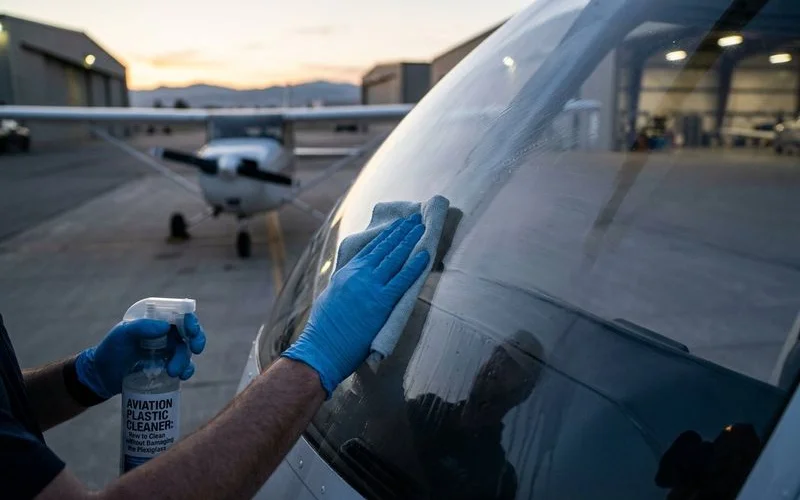
Before touching the surface with any cloth, you must flush away the loose grit. Use a gentle stream of water or a spray bottle filled with distilled water to flood the windshield. Do not use compressed air, as it can drive abrasive particles across the surface at high velocity.
The “Bare Hand” Technique: Many seasoned detailers use their clean, bare hand while flooding the surface. Your skin is soft enough not to scratch the plastic, but sensitive enough to feel if grit is still present. If you feel anything rolling under your hand, stop wiping and rinse more.
For stubborn insect residue—a constant battle here in Idaho during the summer—spray the area thoroughly and let it soak. Allow the water or cleaner to rehydrate the dried bugs for 2-3 minutes. This softens them enough to be wiped away safely.
Step 2: Pre-Wet the Surface
Saturate the windshield with distilled water or your approved cleaning product. The goal is to ensure the entire surface is wet before any cloth contacts the plastic. This floats any remaining fine particles and prevents them from being ground into the surface during wiping.
Step 3: Linear Wiping Only
Apply your aviation-approved cleaner to the microfiber cloth, not directly to the windshield. We always use straight, vertical lines (up and down) or horizontal lines. Never use circular motions.
Circular wiping creates swirl marks that catch sunlight from every angle, creating a “halo” effect that blinds you when flying into the sun. Straight-line scratches are far less visible to the pilot’s eye and do not scatter light as severely.
Step 4: Rinse and Dry
Rinse the surface with distilled water to remove any cleaning product residue. Dry with a clean, dry microfiber cloth using the same straight-line technique with minimal pressure.
Step 5: Apply Anti-Static Treatment
Most aviation plastic cleaners include anti-static agents, but a separate anti-static treatment can be applied for additional protection against dust attraction. This is particularly useful for aircraft stored in hangars where dust is prevalent.
Addressing Existing Scratches
We often get asked if a scratched windshield can be saved. The answer depends on the depth of the damage. For light surface hazing, a specialized polishing system similar to paint correction can work wonders.
- Novus #1 (Clean & Shine): Use this for daily cleaning; it adds a protective luster but has no abrasives.
- Novus #2 (Fine Scratch Remover): This is the industry standard for removing light abrasions and restoring optical clarity.
- Novus #3 (Heavy Scratch Remover): This is for deeper scratches that you can feel with your fingernail.
- Micro-Mesh Kits: For larger restoration jobs (like an entire cloudy window), Micro-Mesh kits offer a series of cushioned abrasives (up to 12,000 grit) that can restore clarity to old acrylic.
You must be careful, though. Polishing actually removes a microscopic layer of the plastic material. If you polish too aggressively or in one spot for too long, you can create optical distortion (a “lens” effect) that warps your view of the runway.
The “Fingernail Test”: Run your fingernail across the scratch. If your nail catches in the groove, the scratch is likely too deep to polish out safely without compromising the windshield’s optical correctness or thickness limits. In these cases, consult your aircraft maintenance technician.
Environmental Factors in Idaho
We tailor our maintenance schedules to the specific challenges of the high desert environment. While these principles apply anywhere in the US, local conditions dictate specific precautions.
Dust and particulate: Summer months bring elevated dust levels from agricultural activity and construction throughout the Treasure Valley. Aircraft stored on tie-downs accumulate grit rapidly, making the pre-cleaning rinse strictly mandatory to avoid grinding that dust into the plastic.
Sun exposure: Prolonged UV exposure causes Plexiglass to yellow and become brittle. A high-quality polish like Plexus or 210 acts as a sacrificial barrier, absorbing UV rays so the plastic doesn’t have to.
Temperature extremes: Large temperature swings between summer days and winter nights cause expansion and contraction in Plexiglass. Cleaning during temperature extremes should be avoided, as the material is more susceptible to crazing when stressed by thermal changes.
Insects: The Boise area’s proximity to agricultural land and waterways means significant insect activity during flying season. Pre-treating windshields with an anti-static product before flight reduces insect adhesion and makes post-flight cleaning easier.
A Note on Regularity
Consistent, gentle cleaning after every few flights is far better for your windshield than occasional aggressive cleaning sessions. Each cleaning session should be as gentle as possible, removing only what has accumulated since the last cleaning. The cumulative effect of gentle, frequent maintenance is a windshield that remains clear and scratch-free for years longer than one subjected to infrequent, heavy-handed cleaning.
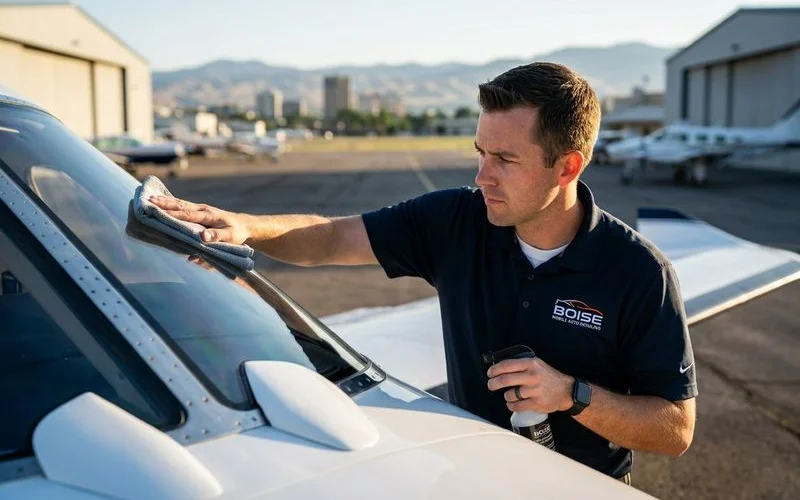
Boise Mobile Auto Detailing Team
Professional detailing specialists serving Boise and the Treasure Valley.